At its crux, UI/UX design has always been about creating experiences—digital or otherwise—for people. But too often, design still slips into what can be called an ego-system mindset, a mode where design or product decisions are made based on organizational requirements, stakeholder opinions, and the likes, rather than the broader ecosystem of users, technology, and evergreen design principles.
Today, as digital products scale into ecosystems of products, services, touchpoints, and stakeholders, this ego-system mindset is no longer the sustainable way to keep going. What we need instead is an ecosystem perspective where designing with interdependence of products/services, collaboration within teams, and long-term technological sustainability in mind is the norm. This shift, rooted in systems thinking, helps move design away from short-term wins and aesthetic fixes toward creating value that grows and lasts.
Stuti Mazumdar - October 2025
“Systems thinking is a discipline for seeing wholes. It is a framework for seeing interrelationships rather than things, for seeing patterns of change rather than static snapshots.”
— Peter Senge
The Iceberg of Design - What’s Seen vs. What’s Hidden?
So, how do we differentiate the two system design perspectives when it involves design decisions as part of the process?
1. Ego-System Design
Envision the homepage of an app. It looks sleek but ignores accessibility. It’s a feature launched quickly to meet deadlines, but at the cost of building an intuitive and accessible experience for users. These are short-term, visible outcomes focused on aesthetics or delivery speed.
2. Eco-System Design
Here, we will follow a design process rooted in user research, feedback loops, and cross-functional collaboration. The design system scales across products consistently. In these systems, the invisible work leads to resilient, user-centered outcomes.
This iceberg analogy helps highlight why so many products “look” great but fail to engage meaningfully because their hidden layers were ego-driven, not ecosystem-driven.
After all, the difference is clear. In ego-system mode, feedback often comes too late, usually when users complain or due to the slow churn rates tracked. Designs are built in silos, with teams assuming they know the “right” solution. In eco-system mode, feedback loops are continuous: usability tests, ethnographic studies, and analytics all integrated into the design processes. Each iteration adapts to what the ecosystem—users, technology, and context—signals back. This makes design resilient, responsive, and future-ready.
Shifting an Organization’s Mindset
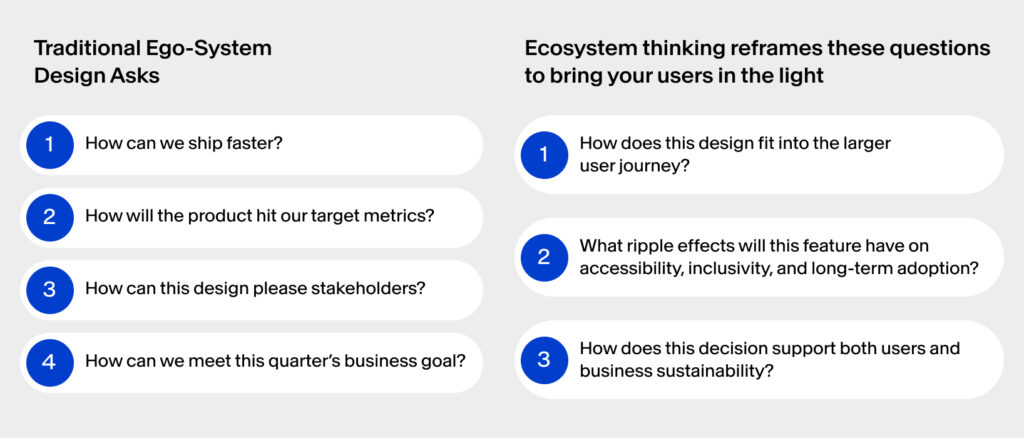
Another critical aspect of adapting to an eco-system, is fostering collaboration as part of the process, In ego-systems, design often operates as control: closed workshops, decisions made by a few, secrecy until launch. But eco-system UX thrives on co-creation. It involves cross-functional teams, including designers, developers, researchers, and business; encourages open communication platforms for feedback; and leverage user involvement as collaborators, not just end-consumers.
The quality of relationships in the system directly impacts the quality of design. A collaborative design culture is harder to build—but it produces more sustainable, scalable outcomes.
“When I think in systems, I stop seeing isolated events and start seeing how everything is connected. Blaming individuals rarely solves anything. If the system’s broken, people will still struggle. So I always ask: what’s the structure behind the behavior?”
— Ankita Bawankar, Service Designer
From Ego-System to Eco-System: How to Make the Shift?
The transition from the ecosystem thinking perspective isn’t easy or abstract. It’s about changing UX practices within the organization:
1. Start with Embed Systems Thinking
Map how your product interacts with users, other systems, and how focused it is on your target audience. Use journey mapping not just for screens, but for ecosystems of touchpoints as part of your digital product.
2. Re-Design Your Wins
Move away from vanity metrics like “time on page” and reward outcomes like user trust, reduced churn, and accessibility scores. This would help you align to bigger, better goals and align yourselves with a better design thinking mindset as an organization.
3. Encourage Collective Ownership
Encourage cross-functional UX teams where designers, researchers, and product owners share accountability. This would push them to design what works best for the users truly.
4. Create Feedback Loops
Don’t rely on one-off surveys or a shallow user calling/interviews exercise. Build real-time feedback loops that translate to analytics dashboards, continuous usability testing, personalization, etc.