In the evolving world of digital products that continue to close the gap between technology-led experiences and human-driven ones, designers continually seek new ways to create intuitive, scalable, and visually compelling designs. One of the most intriguing inspirations comes from the concept called fractal design—one that’s rooted in mathematics and nature and has found its way into modern design frameworks.
Fractals are complex patterns that repeat at different scales at a never-ending capacity, first introduced by the mathematician Felix Hausdorff in 1918. They are often seen in nature, from the branching of trees to the spirals of galaxies. In design, the fractal design framework helps create visually harmonious systems, modular structures, and scalable user interfaces that enhance usability and efficiency. But how does fractal design influence user interface design? And how can designers harness its principles to craft better experiences? Let’s explore.
Stuti Mazumdar - April 2025

Understanding Fractal Design: A Design Approach Based on Mathematical Logic
Fractal design is based on the concept of self-similarity, meaning that patterns repeat at various levels of magnification. This principle has been widely applied in graphic design, digitally created art, architecture, and even software development.
In user interface design, fractals emerge in various aspects including:
- Modular Systems: constituting components that follow repetitive structures.
- Responsive Layouts: with interfaces that adjust dynamically across the different screen sizes or views.
- Design Hierarchy in Systems: where navigation patterns are essential to maintain consistent structures at different levels.
By leveraging fractal design, designers can create systems that feel cohesive, scalable, and visually balanced, regardless of complexity.
The Role of Fractal Design in User Interface Development
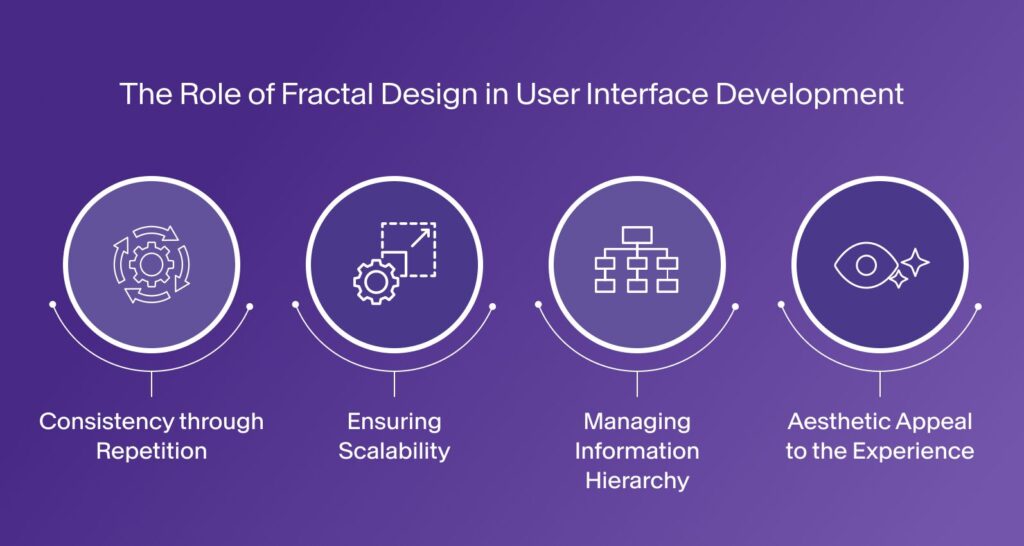
Fractal design, as a design framework, is critical to crafting cohesive and intuitive user interfaces across an experience. Let’s take a look at how:
1. Consistency Through Repetition
One of the key principles of user interface design is maintaining visual consistency across the digital product. Fractal design naturally supports this by repeating elements across different sections of a user interface. Envision a dashboard—it includes cards, buttons, and known interaction patterns, often following a repeating modular structure, ensuring usability and familiarity across screens.
2. Ensuring Scalability
Modern user interfaces must function across a variety of devices, from smartphones to large desktop screens. The fractal design framework ensures that UI elements scale without losing coherence. For instance, experiences built with grid systems use sections that follow a predictable, repeating structure and can seamlessly adjust to different screen sizes while maintaining design integrity.
3. Managing Information Hierarchy
Users interact better with interfaces that follow logical structures and known interaction or design patterns. Fractal design helps maintain just that, creating layered hierarchies when it comes to design elements or content design across the experience. These design elements include navigation menus, submenus, and content blocks that follow nested patterns.
4. Aesthetic Appeal to the Experience
Using fractal principles in UI design enhances visual rhythm, guiding users through interfaces in a way that feels intuitive and natural.
Applying Fractal Design to Modern UI Frameworks
Designers can integrate fractal design principles into their existing design strategy seamlessly, as it works in cohesion with any design framework currently employed. It focuses mainly on:
- Grid-Based Layouts: Using flexible grids that follow repeating modules.
- Component-Based Design: This includes UI libraries that structure components in reusable patterns.
- Data Visualization: This creates fractal-inspired charts and graphs that organize complex information.
By applying these principles, UI design becomes scalable, intuitive, and visually harmonious.