For decades, “branding” was largely a promise made by organizations worldwide; a story told through ads, taglines, and billboards. The formula was straightforward: promise value, and customers will follow.
As we enter 2026, that formula is obsolete. Something fundamental has shifted in how modern brands compete. Products still matter. Pricing still matters. Technology absolutely matters. But what defines brand perception, and ultimately brand adoption, today is experience strategy.
Stuti Mazumdar - January 2026
“You’ve got to start with the customer experience and work back toward the technology, not the other way around.” — Steve Jobs, former CEO of Apple
In the digital economy, a brand is defined not by what it says, but by what it does. Your marketing might promise “innovation” and “speed,” but if your onboarding flow is clunky or your mobile app lags, your brand is defined by that frustration. As the adage goes, your brand is what people say about you when you’re not in the room.
Why Experience Strategy Is Now Business Strategy
Three converging forces have elevated experience design from a UX function to an executive priority:
1. Customers judge brands by their best experience across industries
A consumer doesn’t compare your banking app only to other banking apps. Their digital competence and literacy now allow them to compare it to bigger and better organizations like Amazon, Spotify, or any other app under the sun that may or may not relate to your industry. They’re engaging with new digital experiences every day and using them to find what’s best for them.
This cross-category benchmarking means that experience sets expectation, not category norms.
2. Experience is now the leading driver of adoption
73% of customers cite experience as a critical factor in purchasing decisions, but only 49% say companies deliver on it. The gap has become an opportunity space and the companies with strong experience strategy are capturing that delta.
3. Complexity is rising faster than teams can manually manage
Omichannel-focused journeys, fractured touchpoints, personalization expectations—experience can’t be “designed” in isolation anymore; rather, it must be systematically architected. This is where many organizations fall short.
How Experience Strategy Shapes Brand Perception
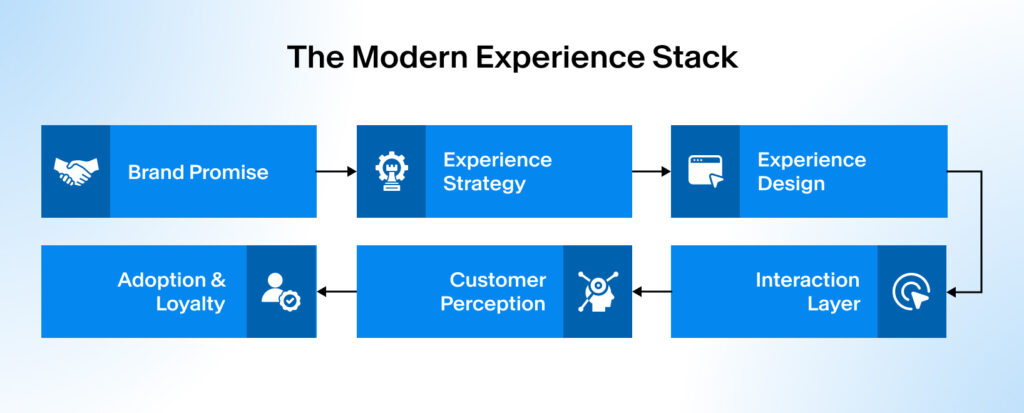
1. Good Experience makes your brand feel coherent
Customers don’t think in departments or in flows. They think holistically—how did the interaction with your brand or product make them feel? How easy was it to interact with the product? And would they want to use it again?
When product, marketing, service, and communication operate on different rhythms, perception fractures.
- Your value proposition feels unified
- Your visual & verbal identity feels continuous
- Your customer service reinforces brand and product promises
- Your digital workflows reflect your brand story
2. Reducing Cognitive Load
Great design removes the effort required to think. It anticipates user needs. Research consistently highlights that better UX design can significantly boost conversion rates by simply removing friction. When a product feels “easy,” users are more likely to integrate it into their daily lives.
3. Building Emotional Connection Through Design
Adoption isn’t just logical; it’s emotional. Micro-interactions (a satisfying animation when a task is complete, or a friendly greeting) release dopamine. These small choices build an emotional bond that turns casual users into loyal advocates.
4. Accelerating Time-to-Value
How quickly does the user experience the “Aha!” moment? Strategic design shortens this path to success. Leaders in product-led growth (lovingly called PLG now) win because they deliver value before asking for payment. The faster a user receives value, the higher the retention rate.
How to Win at Experience Strategy in 2026
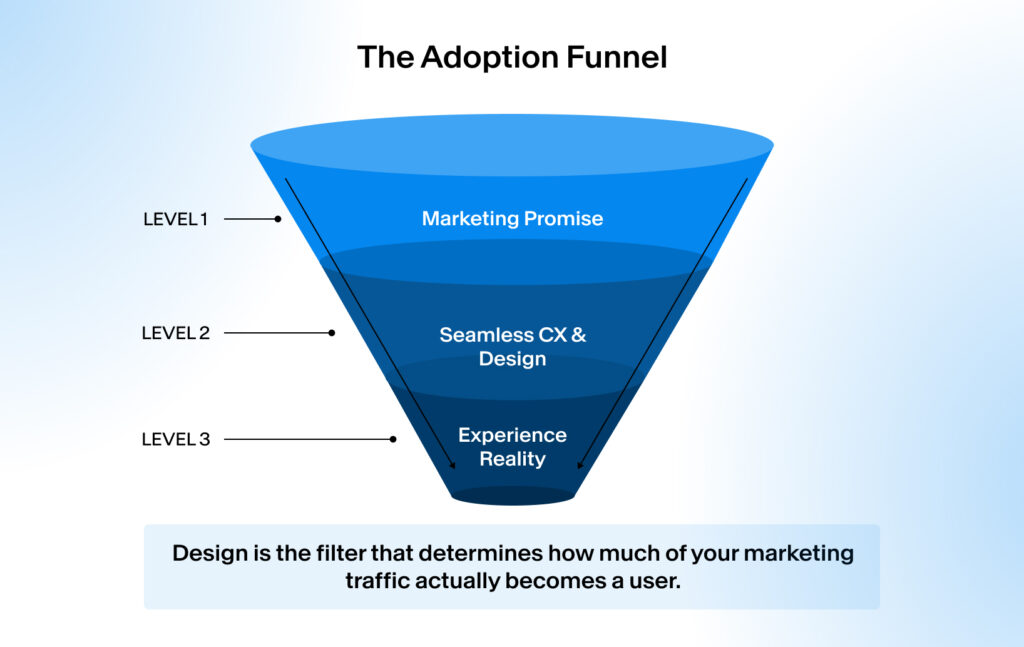
1. Experience Leadership Starts Early
Experience has to shift from downstream execution to upstream decision-making. When experience leadership is part of discussions with stakeholders, they shape what an organization promises in sync with how their product functions and what it delivers.
2. Move from User-Friendly to User-Centric Design
“User-friendly” means the product is easy to use. “User-centric” means the product fits the user’s life. To win, organizations must move beyond demographic data and understand user intent. This involves conducting deep ethnographic research to understand the context in which a product is used.
3. Create a Consistent Cross-functional, Omnichannel Customer Experience
Experience strategy must be holistic. Consistency across customer journeys is one of the most significant predictors of customer satisfaction. The language in a sales email must match the app’s microcopy, and the voice and tone of the help desk. Any break in this continuity fractures brand perception.
4. Use Ethical Design to Build Trust
Dark patterns boost short-term metrics, but they destroy long-term brand loyalty. Successful companies play the long game. They use ethical design to build trust. This means transparency about data usage, easy cancellation flows, and prioritizing user well-being. In a market of skepticism, transparency is the ultimate winning competitive edge.