For years, the product development process was linear—research led to the conception of an idea, helping teams craft the user experience (UX) and eventually reaching prototypes for testing. Each phase had its rhythm, stretching design cycles to 8–12 weeks. That rhythm is now being rewritten. AI-powered tools and generative design systems are fundamentally disrupting this flow, compressing weeks of work into days. But contrary to what many leaders assume, this compression doesn’t just mean faster delivery. The real transformation lies in where time is saved—and how it’s being reinvested.
As we enter 2026, artificial intelligence doesn’t just speed up execution—it enables creative parallelism, continuous real-time updates, and more responsive collaboration between design, product, and engineering teams. The death of sequential phases is giving birth to a new era of parallel exploration.
Stuti Mazumdar - December 2025

What is The Compression Paradox?
Every technological leap comes with its paradoxes, AI-driven tools have become the latest one. On the surface, it looks like design cycles have shrunk from months to mere weeks due to automated analysis, iterations, testing, etc. AI-powered tools, which are now predominantly using the plug-and-play model, can generate wireframes, design components, interactive prototypes, and blocks of code from text prompts within minutes.
But here’s what’s really happening: while execution accelerates 10x, the thinking hasn’t sped up at the same rate as teams around the world are continuing to adapt to the speed with which organizations can now function. The bottlenecks that define product direction, validate hypotheses, and align stakeholders remain stubbornly human. So instead of design cycles simply “shrinking,” they’re reshaping—where time saved in execution is increasingly being reinvested into exploration, iteration, and strategy. This isn’t speed for its own sake; it’s velocity with intent.
Where Does Real Compression Happen?
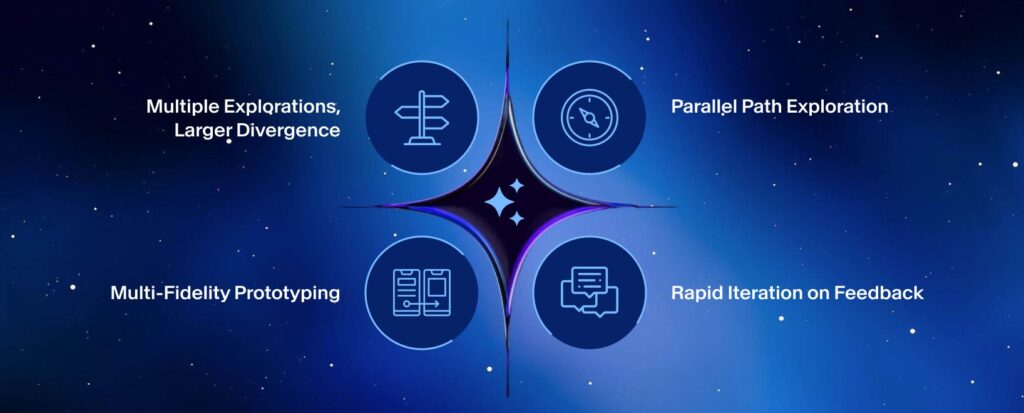
The myth that AI-powered tools compress every stage equally is just that—a myth. The compression is asymmetrical, and the biggest gains happen where generative AI tools help reduce manual cycles.
1. Multiple Explorations, Larger Divergence
Generating 50 variations of a concept used to take a team several days. Now, an AI model can do it in hours. This explosion in divergent thinking allows teams to explore more user preferences and test variations rapidly before narrowing down. Designers aren’t choosing between two good options anymore—they’re evaluating dozens of viable ones.
2. Multi-Fidelity Prototyping
The jump from a sketch to an interactive prototype used to require several handoffs. Now, it can happen within a single design session. Designers can prompt systems to evolve wireframes into mid-fidelity clickable flows instantly—reducing dependency on developers for early testing.
3. Parallel Path Exploration
Perhaps the biggest shift now is that teams can test multiple design directions simultaneously rather than sequentially. Instead of picking one idea, running with it, and iterating only after testing, teams can validate multiple ideas in parallel. They no longer need to stick to a decision to work efficiently and stick to deadlines—exploration of all ideas and choosing the one that sticks best for a product is now possible.
4. Rapid Iteration on Feedback
In traditional workflows, iteration meant scheduling revisions for the next sprint. With AI-assisted prototyping, iteration happens quickly and seamlessly, allowing designers to spend time actually brainstorming for ideas that can bridge the gap between the problems realized during testing and their product.
As 2026 approaches, the most successful teams aren’t just designing faster—they’re designing smarter. They’re embracing a generative design mindset where creativity scales alongside intelligence.
Hidden Bottlenecks In Product Development Teams
The parts of the design process that are most human remain relatively immune to automation. And hence, “bottlenecking” takes place. As we move towards AI-first working environments—leveraging AI to perform tasks that are meticulous, repetitive, and time-consuming—we are catching up with it slowly. However, that speed doesn’t translate to tasks that are still human-led.
1. Stakeholder Alignment Still Takes Time
No matter how quickly prototypes are generated, alignment meetings, approvals, and consensus-building remain analog in speed. Even in AI-driven product teams, human alignment slows velocity.
2. User Research and Validation
AI can simulate user feedback, but can’t replace the nuance of real human context. Research, interviews, and ethnographic insights still move at a human pace.
3. Strategic Thinking Is Still Human-Speed
AI models can offer solutions, but they can’t yet define the right problem since they come from pain points realized by humans. Product strategy, prioritization, and positioning require the kind of interpretive thinking that no algorithm can replicate.
4. The Human Touch
The final polish—the emotional nuance of an interface, the tone of a micro-interaction, the pacing of motion design—often takes longer with AI because teams spend time curating, not creating.
How Product Leaders Can Better Utilize AI-Powered Tools
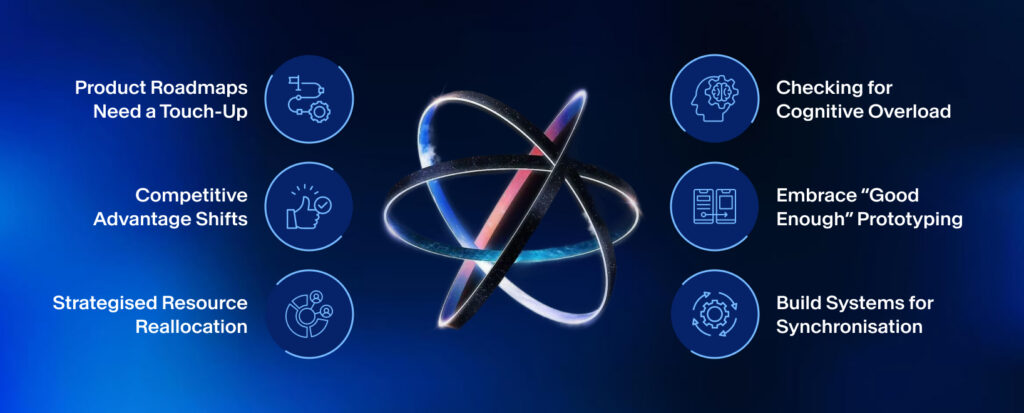
This new rhythm has profound implications for design, product, and business leaders. The only leg up is to strategize for seamless and intentional integration of these automated processes with existing, robust frameworks and systems. This may include:
1. Product Roadmaps Need a Touch-Up
Roadmaps built on 12-week design assumptions are now obsolete. With design cycles now running on swifter, friction-free rhythms, the pace of strategy and execution must realign.
2. Competitive Advantage Shifts
The edge now lies with organizations that can make decisions faster, not just produce faster, as discussed earlier. The time saved in design is only valuable if leadership velocity keeps pace.
3. Strategized Resource Reallocation
With less production effort needed, organizations must reinvest in strategic capacity—problem framing, user research, and experimentation.
4. Checking For Cognitive Overload
AI-driven exploration generates more options than organizations can often evaluate. Without proper governance, abundance can become a new form of inefficiency.
5. Embrace “Good Enough” Prototyping
Perfection isn’t the goal—learning is. Use quick prototypes to test hypotheses that may be just “80% there”, not to finalize aesthetics but to validate design decisions.
6. Build Systems for Synchronization
The greatest challenge of AI-era design isn’t creation—it’s coordination. Designing an org that moves together is the real competitive edge.