For SaaS products and the environments they are utilized in, velocity is everything. Products evolve rapidly, new competitors emerge every year, and customer expectations shift before they even hit the markets. Yet amid this flux, one truth has become inescapable: your user’s first experience inside the product defines your next six months of engagement, retention, and revenue.
At Think Design, we’ve seen this firsthand. When onboarding is treated as a strategic, experience-first discipline that brings delight in the smallest of user interactions, activation rates soar, and retention follows naturally. Because onboarding isn’t the beginning of a user’s journey, but a journey that decides whether a user will ever truly start one.
Stuti Mazumdar & Vidhi Tiwari - August 2024
How Does SaaS Onboarding Impact Retention?
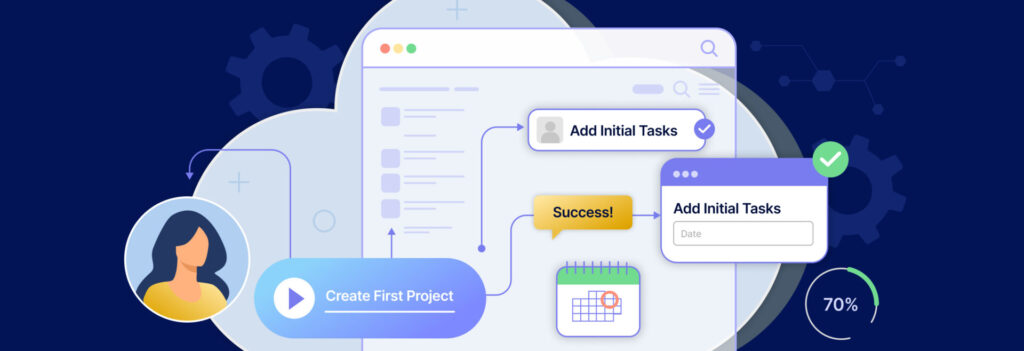
Data tells a consistent story across industries. A study found that 70% of users who fail to find value on their first day abandon the product within a week. What does this mean for SaaS companies globally is simple yet profound – activation on users’ day 1 isn’t an early-stage metric, but a direct predictive indicator of long-term retention.
In the first 24 hours, users aren’t just exploring a new product—they’re subconsciously evaluating whether it will become part of their daily workflow or fade into their digital clutter. The design of those initial interactions must therefore do three things simultaneously:
- Deliver immediate value that is transparent, visible, and delightful
- Build emotional trust
- Reduce cognitive friction to capture the mind share of your users
When onboarding checks all these boxes, it transforms an indifferent trial user into a committed participant.
What’s the Psychology of Day - 1 Activation in SaaS Products?

Behind every great onboarding experience lies behavioral psychology. The most successful SaaS companies have already realized that onboarding is a lot more than just UX. It’s about how humans form habits, respond to feedback, and commit to perceived value.
Here’s what’s happening psychologically in effective onboarding:
1. Leveraging Cognitive Ease
The human brain instinctively avoids friction. A signup flow with too many steps or unclear feedback signals danger, and it triggers drop-offs. The antidote is cognitive ease: progressive disclosure, contextual copy, and familiar interface patterns that make the user feel immediately competent.
Let’s think of Figma’s onboarding. No long forms, no dense tutorials, no information overloading—just a simple “Start Designing” CTA that leads users straight into creation and testing the product out. Learning happens on the go through nudges and walkthroughs, and comfort translates directly into retention.
2. Instant Gratification on Completed Tasks
Humans are wired to respond well to instant reward loops. When they see the impact of their actions—an updated dashboard, a task completed, or data visualized—the dopamine hit creates emotional buy-in. Onboarding should therefore deliver a clear “woohoo moment” within the first few minutes, ensuring to capture this emotion.
A well-timed success screen, small progress bar, toast, or visual confirmation of achievement is more than decoration—it’s neurological reinforcement that “this tool works for me.”
3. Instilling Autonomy From Day 1
Modern users despise feeling “trained.” They want guidance that feels optional with support that is intelligent and forever-present. Plug and play tools like Notion or Webflow achieve this balance beautifully by offering tooltips and walkthroughs that appear when needed, not when imposed.
This provides users with a sense of autonomy, which strengthens perceived experience when using the tool or product, a key predictor of long-term engagement.
4. Social Proofs To Instill Trust
Onboarding that subtly displays a community-like active user count, peer testimonials, or consumer ratings activates the brain’s instinct to trust a product. Trust and adoption accelerate from there.
Together, these psychological levers make onboarding feel effortless, meaningful, and emotionally rewarding—qualities that drive activation and stickiness in the months that follow.
How To Build The Perfect Strategy for SaaS Retention?
Activation and retention are often treated as separate KPIs. In reality, one predicts the other. Users who find value quickly form habits around the product. Those habits, when reinforced through continuous feedback and evolving value delivery, solidify into retention.
ProfitWell confirms this by stating that activated users have up to 80% higher retention after six months. The correlation exists because activation and retention are both reflections of design maturity in the organization. Products that prioritize clarity, relevance, and emotional reward from day one rarely struggle to keep users engaged later.
“Activation isn’t a milestone—it’s a mindset. The moment a user feels in control, retention becomes an organic outcome.” — Deekshit Sebastian, Design Studio Head at Havas Think Design
Designing for Activation: Five Strategic Practices

1. Just Breakdown the First Task, Not the Full Tutorial
Instead of showcasing every feature in an overwhelming walkthrough, design the onboarding flow around the single action that best demonstrates value. When internal messaging tools used across organizations prompt users to “send your first message,” it’s not random; it’s habit formation science in action.
2. Pair Personalization with Precision
Users don’t need hyper-personalization at all instances of using the product; they need relevance. Smart segmentation based on user goals or roles can tailor onboarding messages and pathways subtly, increasing the sense of recognition and intent alignment.
3. Make Success Visible at All Times
Visual dashboards that track onboarding progress, highlight completed steps, and reward engagement foster a sense of accomplishment. These micro-feedback loops sustain user momentum.
4. Embed Learning into Actions
Replace static tutorials with contextual, in-app discovery. When users learn by doing, guided by prompts that appear precisely when needed, knowledge retention and engagement multiply.
5. Use Real-Time Data for Iteration
Onboarding must evolve as users do. By tracking engagement analytics and friction points, design teams can identify where users drop off and optimize flows continuously. Every redesign cycle should be driven by behavioral data, not assumptions.