When artificial intelligence entered the enterprise vocabulary, unfortunately, many leaders saw an immediate equation: if AI can automate X% of my team’s work, I can cut X% of my headcount.
It’s intuitive. It’s measurable. It looks fantastic in a quarterly P&L report.
And it’s completely wrong.
Stuti Mazumdar - January 2026

The real return on investment (ROI) from AI implementations isn’t about replacing people — it’s about reimagining what they can do. Leaders who approach AI adoption as a cost-cutting lever risk missing its most transformative potential, the ability to unlock higher-value, higher-velocity work with the same people.
This mindset isn’t new. Every automation wave — from the assembly line to spreadsheets — started with the same premise: do the same work, faster, with fewer people. The allure is powerful, we get it. It’s immediate, measurable, easy to explain to boards, and hence, intoxicating. But what it gains in simplicity, it loses in strategy. Short-term optimization creates long-term stagnation. Because when everyone’s automating, the differentiator won’t be who saved the most cost — it’ll be who redirected that capacity into innovation, foresight, and adaptability.
In 2026, with leading enterprises scaling AI initiatives across functions, the narrative has shifted. It’s no longer about headcount reduction but organizational redesign — how AI frees human teams to focus on judgment, creativity, and empathy.
How Does Cutting Teams Cost The Organization?
Cutting headcount to prove ROI calculations is like selling your compass to lighten the load; you might move faster, but you’ll soon be lost. Here’s what actually happens when organizations equate automation with downsizing:
- Your best people leave first. High performers interpret layoffs as a signal that the organization values efficiency over excellence. They don’t wait to see who’s next.
- You lose institutional knowledge right when you need it most — to train, calibrate, and manage your AI tools effectively.
- Morale collapses. The surviving team becomes risk-averse, focusing on doing things “right” rather than doing new things better.
- You still need humans for judgment. AI can replicate production, but it can’t replicate discernment. Design, strategy, and empathy still demand human oversight.
- Competitors who reallocate, not reduce, will outpace you. Within 18–24 months, they’ll deliver faster, experiment more, and innovate deeper — while you’re still cutting budgets.
Most dangerously, this approach breeds a narrative of AI versus humans instead of AI with humans. Once that cultural shift happens, rebuilding trust is almost impossible.
The post-2025 reality: companies that embraced integrated AI workflows where humans and machines co-create in real time report up to 40% improvement in operational efficiency and 25% higher customer satisfaction scores.
How to Best Use The Reallocation Strategy?
The real opportunity isn’t in subtraction — it’s in redirection. If AI-powered workflows save time, the question isn’t “who can we let go?” but “what can we do now that we couldn’t before?”
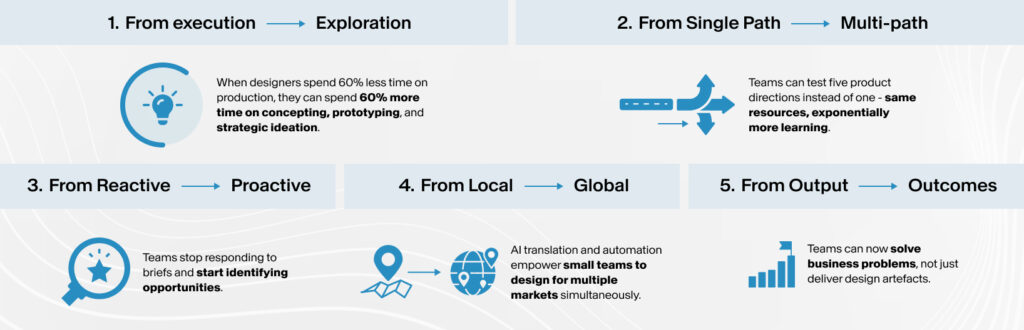
What’s The Reallocation Playbook?
To harness this reallocation advantage, leaders need a deliberate plan — one that aligns structure, incentives, and metrics with AI’s new rhythm.
1. Audit Time Allocation: Map where creative and product teams spend time today?
2. Identify Resource Gaps: Which high-value areas are currently starved of attention?
3. Redesign Roles: When AI handles 40% of execution, what new capabilities emerge?
4. Reinvest in Human Strengths: Redirect AI dividends toward skills that machines can’t replicate, such as cultural insight, strategic foresight, and emotional intelligence.
5. Redefine KPIs: Shift from the generic ‘deliverables per month’ model to ‘business impact per project’. Measure progress through ROI calculations rooted in innovation, agility, and value creation.
“It’s not about displacing humans, it’s about humanizing the digital experience.” — Rob Garf, Vice President and General Manager, Salesforce Retail
Progressive organizations in 2026 are already experimenting with hybrid roles where team leads manage the interplay between machine learning systems and creative decision-making processes.
If you’re calculating AI ROI based on how many people you can cut, you’ve already lost the advantage. Your competitors aren’t asking how to do the same work cheaper — they’re asking how to do new, impossible things. The true ROI of AI implementations lies in what you choose to do with the time it gives you. Reallocation isn’t about saving money. It’s about buying the future and ensuring your best team is the one building it.