Stuti Mazumdar & Vidhi Tiwari - August 2024
Here are seven things worth evaluating when you’re choosing a UI UX agency for your business.
1. Does the agency align with your business goals and vision?
Cultural alignment significantly affects the success of an agency collaboration. An agency that understands and aligns with your business goals and vision from the first conversation will invest differently in the work and bring sharper judgment to the design decisions that follow.
Evaluate potential agencies on their values, their working approach, and how they discuss problems that don’t have obvious answers. A productive partnership starts with a shared sense of what you’re building toward.
“Aligning with a brand’s values and culture helps us create a commitment, driving better solutions and stronger partnerships.“ — Deepali Saini | CEO at Think Design Collaborative
2. What design processes and frameworks does the agency use?
One of the strongest signals of depth in a UI UX agency is whether it has developed its own design processes and frameworks. Proprietary methodologies reflect years of accumulated judgment about what works across industries and what doesn’t. They also signal an agency that treats strategic design as a practice, not just a deliverable.
When evaluating agencies, ask how they approach problems before they propose solutions. An agency that can walk you through how it makes design decisions and why, has a methodology that holds up under pressure. An agency that can’t articulate its process has style without structure.
3. How strong is the agency's UX research and user research capability?
For design that genuinely solves problems, the work has to be backed by sufficient evidence to understand what users actually need. That requires an agency with serious UX research capability; not as a phase that happens before “real” design begins, but as a discipline that informs decisions throughout the engagement.
The strongest agencies move fluidly between qualitative and quantitative methods: user research, usability testing, contextual interviews, surveys, and competitive analysis. They know which method answers which question, and they bring that evidence into design conversations so design decisions are informed by what users actually do rather than what teams assume.
AI-augmented research is part of the toolkit today. The agencies that use AI well treat it as a synthesis tool, not a replacement for understanding user expectations. The line between AI-assisted insight and ground-truth user observation matters more than ever, and an agency that knows the difference is one worth listening to.
4. Is the team cross-disciplinary across design and product?
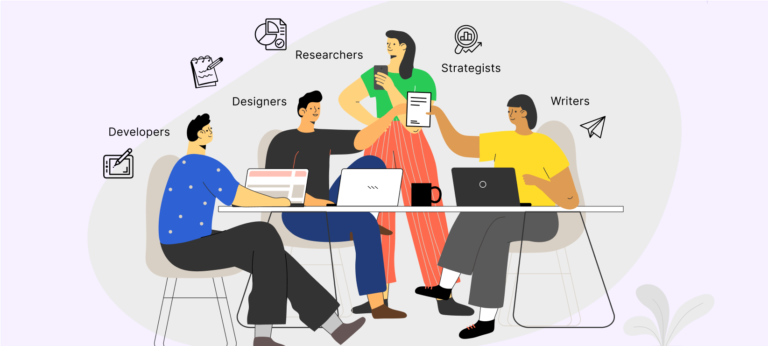
The best design projects come from teams with range. A cross-disciplinary team — designers, researchers, writers, strategists, accessibility specialists, and engineers — brings a holistic view to digital products that single-discipline teams can’t.
When evaluating agencies, ask about the composition of the team that would actually work on your project. The strongest agencies don’t generalize across roles to fit a budget; they staff projects with the right mix of disciplines and protect that mix through the engagement.
This matters more now than it did two years ago. AI tools have made parts of design execution faster, which has tempted some agencies to trim their teams. The agencies that hold the line on cross-disciplinary staffing, bringing real researchers, real content designers, real engineers, are the ones whose user interfaces still feel like they were thought through end to end. The complete user experience shows it.
5. Does the agency have industry depth and large-scale project experience?
A diverse portfolio is impressive, but industry-specific depth is what matters when you’re building for a regulated, complex, or technically demanding category. Agencies that have worked across other organizations in your industry — banking, healthcare, enterprise, telecom, education — understand the constraints, compliance environments, and edge cases that shape what good design looks like in that context.
Look at their body of work with depth, not just visual range. The strongest case studies tell you what changed for the client, not just what got designed. UI UX design agencies with experience on large-scale projects bring judgment about complexity, scale, and the institutional realities that come with enterprise-grade work. That judgment is hard to fake.
6. How does the agency tie design to business outcomes?
This is the question that separates a service provider from a strategic partner. Design that doesn’t connect to measurable outcomes — conversion rate, retention, NPS, engagement, support-ticket reduction — isn’t a strategic design. It’s decoration with a process diagram attached.
When evaluating agencies, ask how they measure their own work. Ask how the metrics shaped past design decisions. Ask what they would have done differently if a launch didn’t move the numbers they were targeting. An agency that can answer those questions has UX strategies built around business impact.
This is also where user-centered thinking becomes a business proposition rather than a value statement. Designing around real user behavior and tracking whether the design actually changed that behavior is what turns design work into outcomes that compound over time.
“Design without a measurement story is decoration. Design tied to business impact is leverage, and it’s what a real design partnership is built on.” — Deepali Saini | CEO at Think Design Collaborative
7. Does the agency offer post-launch design support?

A great UI UX design agency stays committed to the product past launch. Design is iterative, not transactional. Subject to project timelines and contracts, the right agency offers continuous support — monitoring usage data, surfacing what’s not working, and iterating on the work as the product matures.
Digital products evolve faster than they did two years ago. AI-driven features, regulatory shifts, and changing user behavior all mean that what launched in Q1 may need real rework by Q4. Agencies that understand design as a continuous practice, not as a project with an end date, are the ones whose work holds up over time.
Choosing a UI UX agency to collaborate with is genuinely difficult. It’s also a decision that compounds — the work shapes user experience, conversion, retention, and the entire business impact of the product for years after launch.
The ideal agency isn't a service provider working on a brief. It's a strategic partner invested in your business outcomes — one that brings judgment, methodology, research rigor, cross-disciplinary depth, and a clear connection between design work and business metrics.
By making informed choices and partnering with an agency that operates this way, you set the conditions for design that does more than ship; it changes how the business performs.