Digital accessibility is all about creating websites, apps, and internet technologies, that is, digital experiences, accessible to anyone, regardless of the impairment they face. The purpose of designing with accessibility in mind is to provide a more unbiased internet experience for all; one where the experience, perception, accessibility, understanding, interaction, and participation with fellow web surfers is possible for persons with physical or cognitive disabilities as it is for able-bodied people.
Stuti Mazumdar & Vidhi Tiwari - April 2024
What is Digital Accessibility?
In today’s technology-driven world, access to digital content and technology has become more important than ever before. However, many individuals with disabilities have faced significant barriers in accessing and utilizing digital content. To bridge the gap between relevant information and specially-abled individuals, special efforts are made to craft accessible experiences.
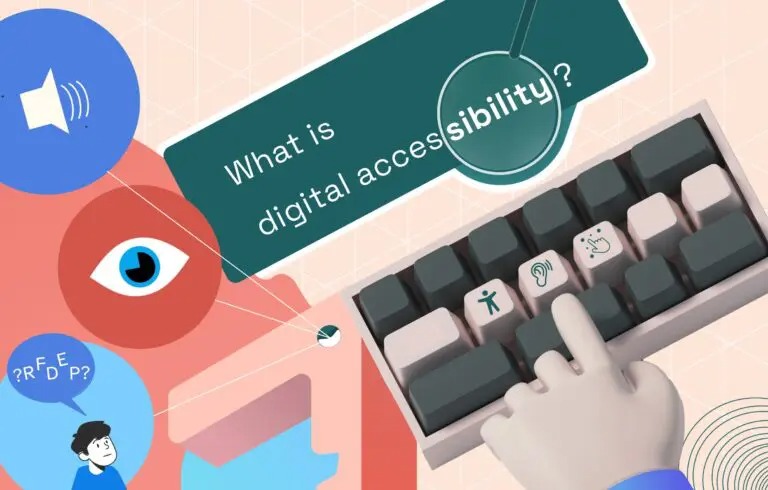
Web or digital accessibility is the inclusive practice of making websites, digital tools, and technologies accessible and usable for people with disabilities. When digital accessibility is achieved, it means specially-abled users across the globe can successfully perceive, understand, navigate, interact with, and contribute to the online world.
Why Does it Matter?
Walking into a healthcare facility, you would expect to be treated the same as any different person walking in with you. The same goes for schools and colleges, government facilities, or something as common as a grocery store. All experiences should be similar, if not identical, and accessible to people with disabilities at all times. After all, it is only fundamentally right that everyone has equal access to the same content, since diversity, equity, and inclusion are the cornerstones for a utopian digital experience that we aim for.

In an era where technology permeates every aspect of our lives, from education and employment to communication and entertainment, excluding individuals with disabilities from digital spaces perpetuates inequality and restricts their opportunities. Embracing digital accessibility not only aligns with principles of inclusivity and diversity but also makes good business sense. With one in five people identifying with a disability statistic, it only is in the benefit of an organization to ensure all digital content and products are devised to be accessible to estimate an increase in their market share by 20% A more accessible digital world enhances user satisfaction, expands market reach, and fosters innovation by tapping into the diverse perspectives and talents of a broader audience. Moreover, as legal frameworks worldwide increasingly mandate digital inclusivity, organizations that prioritize accessibility are not only meeting regulatory requirements but also contributing to a more equitable and just society. Ultimately, digital accessibility is a fundamental right, empowering individuals with disabilities to navigate and contribute to the digital world on equal terms.
The History of Accessibility
The history of digital accessibility is a testament to the progress made in recognizing the importance of inclusivity in the digital realm. From the early days of computing to the present, the journey towards accessibility has been marked by collaboration, legislation, technological advancements, and a growing awareness of the diverse needs of individuals with disabilities.
The Rehabilitation Act of 1973
The Rehabilitation Act of 1973 marked the beginning of the legal acceptance of accessibility by the government. A critical law was passed prohibiting federal agencies and third-party contractors from actively or passively discriminating against individuals with physical or cognitive disabilities.
Americans with Disabilities Act (1990)
The Americans with Disabilities Act was released in 1990, commonly referred to as the ADA. It consisted of guidelines on making public spaces, such as parks, malls, movie theaters, etc. more accessible for specially-abled individuals through physical means, including wheelchair ramps, larger stalls, railings on staircases, braille on elevator buttons, etc. As an extension, Tim Berners Lee considered making the World Wide Web an accessible experience. In 1996, the Department of Justice, DOJ, followed suit and accepted websites as a matter of “public accommodation” to further the cause.
Maguire v Sydney Organizing Committee (1999/2000)
Several years following the impactful statement by the Department of Justice (DOJ) regarding the application of Title III to digital content, Bruce Maguire initiated legal proceedings against the Sydney Organizing Committee for the Olympic Games (SOCOG). Grounded in Australia’s Disability Discrimination Act, Maguire contended that SOCOG had discriminated against him and several other visually impaired individuals by neglecting to provide information in Braille format. Despite SOCOG’s vigorous defense, Maguire ultimately emerged victorious, leading the court to mandate the remediation of SOCOG’s website.
Amendment of Section 508 (1998)
To expand the Rehabilitation Act of 1973, Section 508 was pushed to effect on the contractors for the federal government. It stated that organizations and the federal government wanting to pursue business with the government need to have accessible digital content and assets.
Owing to the lack of knowledge about technology, this act coming to light was a milestone that set the course of the internet that we know today.
Web Content Accessibility Guidelines (WCAG 1.0) Released (1999)
Tim Berners Lee, a keen advocate for accessible web experiences for individuals with disabilities, along with his web guidelines group, introduced us to WCAG 1.0 in 1999. It included 14 guidelines, with each covering a specific element of web accessibility, and provided 65 checkpoints to make the web a more inclusive place.
WCAG 2.0 Released (2008)
A decade after releasing the WCAG 1.0, the web guidelines group released an updated version, WCAG 2.0. Building on its predecessor, it comprised four principles namely, perceivable, operable, understandable, and robust. They paired these principles with more guidelines for developers to ensure an accessible web experience for all users.
WCAG 2.1 Released (2018)
After another decade, the web guidelines group released yet another version of the web content accessibility guidelines, WCAG 2.1. It emphasized the plight of the underrepresented who were missed when putting together WCAG 2.0. This included more information on accommodating those with cognitive disabilities. These included different kinds of impairments including:
- Auditory
- Cognitive/intellectual
- Neurological (including neurodiverse, epilepsy, etc.)
- Physical
- Speech
- Visual
What Makes Digital Content Accessible?
The Content Accessibility Guidelines WCAG remain the global benchmark for accessible design, but the standard has moved significantly since 2018. WCAG 2.2, released in October 2023 and now the recommended legal standard for ADA, Section 508, and the European Accessibility Act, added nine new success criteria strengthening accessibility for users with cognitive disabilities, low vision, and mobile users specifically. The four foundational POUR principles remain at the core:
1. Perceivable
People can perceive digital content through one of their senses. For instance, individuals with visual impairment can access information on a web page through a screen reader.
2. Operable
People can use interactive elements for an altered digital experience. For instance, individuals with limited hand mobility can use dictation software to click buttons.
3. Understandable
People should have access to consistent and predictable content, making it easy to use, particularly important for users relying on assistive technologies to identify links and actions quickly.
4. Robust
People should have access to websites and digital experiences crafted to meet accessibility standards, regardless of the technology they use to access them.
What was new in WCAG 2.2 is a sharper focus on mobile apps and touch interfaces— minimum target sizes, focus visibility, and accessible authentication—reflecting how dramatically the access to information landscape has shifted to mobile-first.
Looking ahead, WCAG 3.0 is under active development and represents the most significant rethink of accessibility guidelines since the beginning. It replaces the binary pass/fail model with a graduated Bronze, Silver, and Gold scoring system, expands scope beyond web content to cover the full digital ecosystem, including apps, AR/VR, and IoT, and adds substantive new guidelines for cognitive accessibility, an area WCAG 2.x largely underserved.
The Legal Landscape Has Shifted — What Teams Need to Know
Accessibility is no longer just a design principle. It is enforceable law across more markets than ever before. As of June 28, 2025, the European Accessibility Act (EAA) came into full enforcement across EU member states. It requires any business trading in the EU, regardless of where it is based, to ensure its digital products meet the accessibility requirements aligned with WCAG 2.1 AA and EN 301 549. This affects websites, mobile apps, e-commerce platforms, banking services, and more. Non-compliance exposes organizations to penalties set independently by each member state.
In the United States, Section 508 and ADA Title III continue to evolve through litigation, with courts consistently affirming that inaccessible digital content constitutes discrimination. The DOJ’s final rule under ADA Title II now mandates WCAG 2.1 AA compliance for state and local government digital services. The takeaway for any team building digital products in 2026: accessibility standards are a legal baseline, not a design aspiration.
Emerging Technologies Driving Accessibility
As technology continues to evolve, so do the opportunities and responsibilities for accessible design. Now, AI-powered tools hold the capacity to generate image descriptions and improve speech-to-text accuracy. That potential—described to be a dream before the AI-boom—is now a reality, and the landscape has grown significantly more sophisticated.
AI is actively reshaping what assistive technologies can do. Conversational screen readers powered by large language models — like Screen Reader AI, a browser extension using GPT-4o — now construct live semantic scene graphs of web pages, generate rich visual interpretations for blind and low-vision users, and enable natural dialogue-based navigation rather than linear command sequences. Early findings suggest these tools reduce cognitive load and task completion time compared to traditional screen readers — a meaningful leap for access to information on complex, dynamic web content.
Platforms like accessiBe use AI to automatically scan digital products for missing alt text, optimize keyboard navigation, and adjust interfaces for screen reader compatibility in real time. Tools like these are lowering the barrier for teams to build accessible products and services from day one, rather than retrofitting compliance after launch.
That said, a critical design principle holds: AI-generated accessibility features are not a substitute for intentional, human-led accessible design. Automated tools can catch a significant proportion of technical failures, but they cannot replace the empathy, context, and user research that goes into designing experiences that genuinely work for people with disabilities.
“Accessibility built on automation alone is compliance. Accessibility built with intention is inclusion. The difference shows up the moment a real user interacts with your product.” —Deepali Saini | CEO at Think Design Collaborative
Accessibility Advocacy Through Social Media
Social media platforms are becoming powerful tools for advocacy, allowing individuals with physical or cognitive disabilities to connect with the world around them, share their experiences, and raise awareness about the issues they face. Social media played a crucial role in amplifying the voices of those advocating for more inclusive digital spaces.
In response to growing pressure, major platforms have implemented accessibility features. These include alt text for images, autogenerated closed captioning for videos, and increasingly, AI-generated descriptions for visual content.